
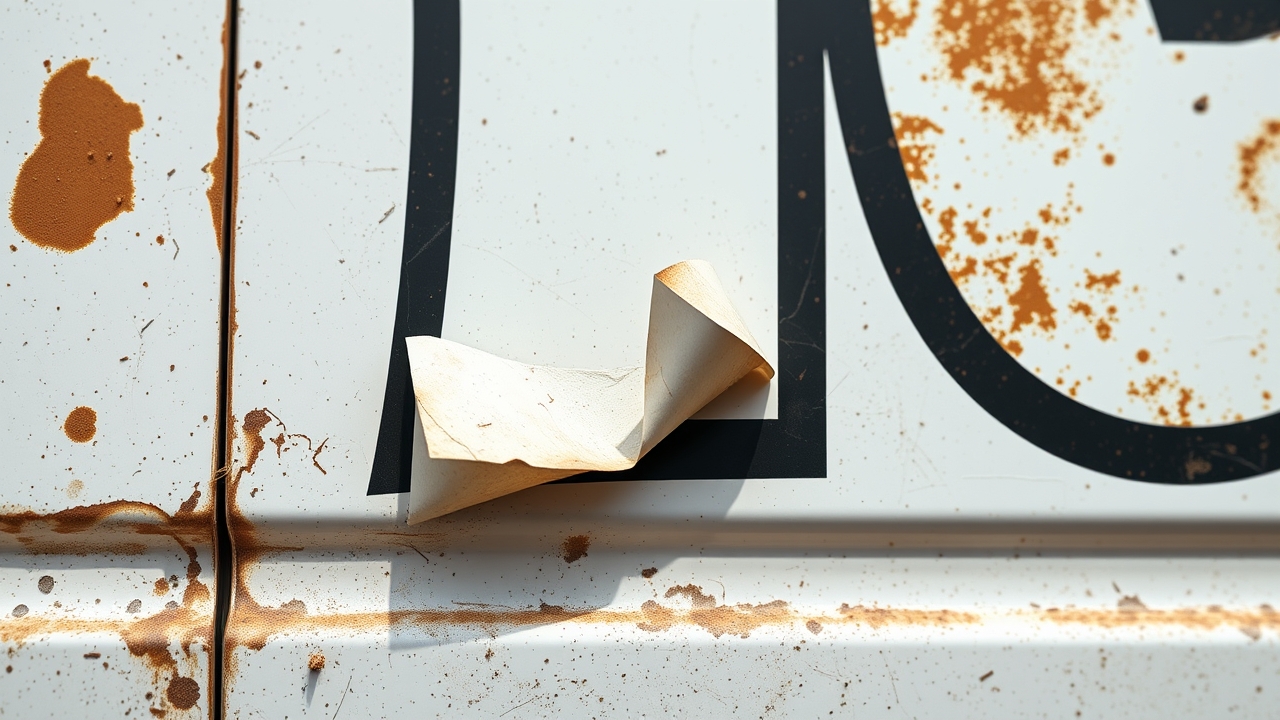
Vinyl lettering on a work truck should last 5 to 7 years outdoors under normal conditions. So when a contractor calls us because their lettering is curling up after 8 months, something went wrong. Vinyl peeling early almost always traces back to one of seven specific root causes, and most of them are preventable.
Vinyl Peeling Cause 1: Poor Surface Preparation
This is the number one reason vinyl peels early, by a wide margin. The adhesive on Oracal 651 or 3M Scotchcal IJ180 is designed to bond to a clean, dry, slightly porous surface. Anything sitting on top of the paint (wax, polish, silicone protectant, road film, even fingerprints) acts as a release layer.
The fix is aggressive prep. Wipe the application surface with isopropyl alcohol at 70 percent concentration or higher, using a fresh lint-free cloth. Do not use paper towels; they can leave fibers. Let the surface air-dry for at least 2 minutes before peeling backing paper. On freshly detailed vehicles, a second wipe is worth the extra 30 seconds.
One real-world scenario we see often: a fleet manager applies lettering to 6 new vans the day they arrive from the dealer. Dealer prep includes protective wax on the paint. That wax must be fully removed before vinyl installation, or peeling at the corners starts within 60 to 90 days.
Cause 2: Application Below Minimum Temperature
Pressure-sensitive vinyl adhesive needs warmth to flow into the substrate and create a strong bond. Below 50 degrees Fahrenheit, the adhesive becomes stiff and never fully activates, even after the temperature rises.
We installed lettering on an HVAC company’s truck once in October, midday, when the air temperature was 55 degrees. The metal door surface read 42 degrees with an infrared thermometer. Four months later, the edge corners were lifting. The surface temp was the culprit.
- Minimum safe application temp: 50 degrees Fahrenheit (substrate surface, not air)
- Optimal range: 60 to 80 degrees Fahrenheit
- Above 95 degrees: adhesive can over-activate and cause bubbles or stretch
In winter, move the vehicle inside and let the panels warm up for at least 2 hours before installing. For detailed cold-weather guidance, see our post on cold weather vinyl application failures.
Cause 3: Wrong Vinyl Grade for the Application
Not all vinyl is rated for the same environment. There is a real and meaningful difference between an Oracal 631 (interior, removable adhesive) and an Oracal 651 (exterior, 6-year rated). If someone sources “cheap vinyl letters” online and they happen to be 631 or an off-brand calendered film with a 2-year rating, outdoor exposure will peel them fast.
| Film Type | Rated Life | Right Use | Vehicle Use? |
|---|---|---|---|
| Oracal 631 | 2 years indoors | Walls, windows, displays | No |
| Oracal 651 | 6 years outdoors | Vehicle lettering, signage | Yes |
| 3M Scotchcal IJ180 | 7 years outdoors | Vehicle wraps, fleet | Yes |
| Avery MPI 1005 | 7 years outdoors | Vehicle wraps, fleet | Yes |
| Generic calendered | 1-3 years | Short-term promo | Risky |
All lettering we ship from Hoosier Decal is cut from Oracal 651 or equivalent exterior-rated cast vinyl. If you are unsure what grade you have, the backing paper often lists the product series.
Cause 4: Paint Surface Issues
Two paint problems cause premature vinyl peeling:
Fresh Paint Not Fully Cured
New automotive paint outgasses solvents for 30 to 60 days after application. If vinyl goes on during this window, the solvents work under the adhesive layer and break the bond. The industry standard recommendation is to wait at least 30 days after a paint job before applying vinyl. We tell customers 45 days to be safe.
Chalky or Oxidized Paint
On older vehicles, the clear coat can oxidize into a chalky surface layer. Vinyl bonds to that loose layer, not the solid paint beneath. When the chalky layer sheds (as it naturally does), it takes the vinyl with it. There is no fix short of paint correction before installation.
Cause 5: Exposure to Harsh Chemicals
Automatic car washes with high-alkaline soaps, pressure washers aimed directly at vinyl edges, diesel fuel splashes near fuel caps, and certain engine degreasers will all degrade vinyl adhesive over time. The edge of a letter is the most vulnerable point.
Fleet vehicles that go through automated truck washes weekly see this effect most clearly. High-pressure water hitting a letter edge at a 90-degree angle is essentially prying the film up, repeatedly. It is a mechanical and chemical attack at the same time.
A practical rule: aim pressure washer nozzles parallel to the vinyl surface, never directly at an edge. Use touchless washes or hand washing when possible.
Cause 6: Unsealed Edges on Cut Letters
Die-cut individual letters leave exposed adhesive edges on all four sides of every letter. These raw edges are the starting point for nearly every peeling failure we see on vehicles that are 2-plus years old. Once moisture or chemicals get under an edge, the peel spreads inward.
The solution is an application fluid or dedicated edge sealer applied after installation. Some installers use Rapid Tac or similar products. A thin bead of clear vinyl-compatible adhesive along exposed letter edges, applied with a toothpick, can add years to the installation. This step is rarely mentioned in basic installation guides but makes a significant difference in humid or salt-air environments.
For step-by-step installation advice, our guide on how to apply vinyl letters to truck doors covers edge-sealing in detail.
Vinyl Peeling Cause 7: Low-Quality or Off-Brand Film
The vinyl decal market has a lot of unbranded or rebranded low-grade film. Adhesive formulations in budget film often use cheaper acrylic blends with lower initial tack and poor UV stabilization. The adhesive yellows and weakens under sunlight, and peeling starts at 18 to 24 months instead of year 5 or 6.
Name-brand films (Oracal, 3M Scotchcal, Avery Dennison) cost more for a reason. The raw material cost difference between a cheap generic and Oracal 651 on a set of truck door letters is maybe $4 to $8. The difference in longevity is years. When we quote a job, we tell customers exactly what film grade they are getting.
Frequently Asked Questions
Can I re-stick vinyl that is peeling?
If the adhesive layer is still intact and the vinyl is not yet brittle, you can sometimes use a vinyl edge adhesive (like 3M Super 77 or Rapid Tac Rapid Remount) to re-bond peeling edges. Clean the area with isopropyl alcohol first. This is a repair, not a permanent fix; if the root cause is contamination or wrong film grade, the peel will return.
How long should quality vinyl lettering last on a truck?
Properly applied Oracal 651 or 3M Scotchcal on a clean painted vehicle surface, in a normal climate, should last 5 to 7 years before showing significant fading or edge lifting. Vehicles in extreme UV environments (Arizona, Florida) or those going through daily automated washes may see that shortened to 4 to 5 years.
Does color affect how quickly vinyl peels?
Color does not directly affect peel rate, but it affects UV absorption. Dark colors (especially black, dark red, and navy) absorb more heat, which can cause the adhesive to soften and re-flow over time, sometimes leading to edge movement. In extreme heat climates, cast vinyl is recommended over calendered film for dark colors, as cast vinyl is more dimensionally stable under heat cycling.
My vinyl peeled after just one winter. What happened?
One-winter peeling almost always traces back to temperature at installation (too cold), surface contamination, or a film not rated for exterior use. Road salt is also a factor; it is chemically corrosive to exposed adhesive edges. If the installation happened in fall and the peeling started by spring, cold installation conditions combined with road salt exposure is the most likely explanation.
Will applying vinyl over existing vinyl cause early peeling?
Yes, often. Vinyl-over-vinyl installations have two bonding interfaces (new adhesive to old vinyl surface, and old vinyl to paint), both of which can fail. The trapped air at the old vinyl edges also tends to transfer. Best practice is to remove old lettering completely before applying new, especially if the old vinyl has been on for more than 3 years.
What finish is more resistant to peeling, matte or gloss?
Finish type does not significantly affect peel resistance. Both matte and gloss versions of the same Oracal product line use the same adhesive system. That said, matte films can be slightly more sensitive to heat-based edge sealing.
Next Steps
If your vinyl is peeling and you need a fresh set cut from exterior-grade film, Hoosier Decal has you covered. We have been cutting lettering from Oracal and 3M materials in Indiana since 2003, and we ship nationwide. Head to create vinyl lettering to configure your replacement set, or upload artwork if you have a logo file ready. Most orders ship within 1 to 3 business days.
