
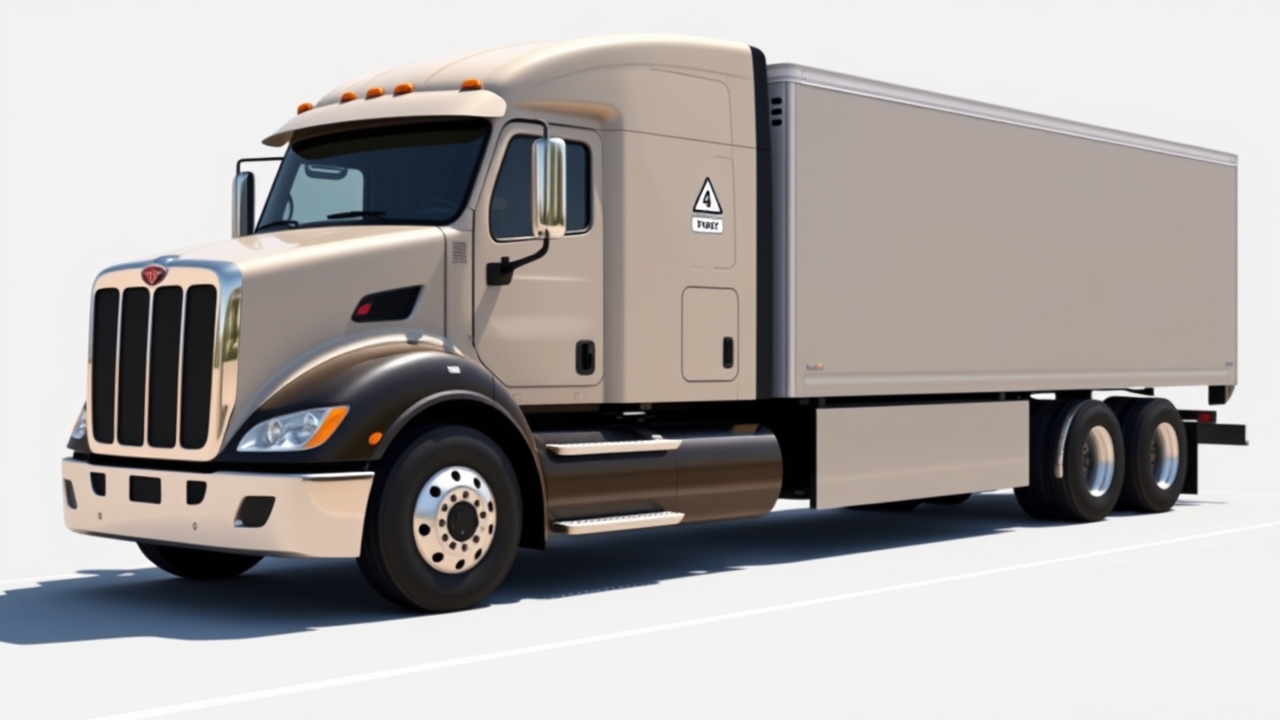
CDL truck marking requirements sit at the intersection of federal FMCSA marking requirements rules and state motor carrier regulations, and they apply to the vehicle itself, not just the driver’s license. A CDL truck marking violation during a Level II or Level III inspection goes on the vehicle’s safety record and affects the carrier’s CSA score, which means it matters even if the driver is not cited personally.
Federal Marking Rules for CDL Trucks
The FMCSA governs vehicle markings for commercial motor vehicles under 49 CFR Part 390.21. This regulation covers any self-propelled commercial vehicle with a GVWR over 10,000 lbs operating in interstate commerce. CDL trucks by definition fall into this category since the CDL threshold itself is 26,001 lbs GVWR.
The regulation requires markings on both sides of the vehicle. It does not just mean the driver’s side semi truck door lettering. Both sides must display the same information. A truck with perfect driver-side lettering and nothing on the passenger side is still out of compliance and will be cited at an inspection.
When Did These Rules Take Effect?
The current marking rules under 49 CFR 390.21 have been in place since 1995, with periodic amendments. The 2-inch minimum letter height and the dual-side requirement date from that era. FMCSA has not changed the core letter size requirement since then, but enforcement scrutiny has increased as the agency’s CSA scoring system creates more consequences for marking violations.
Required Information on CDL Trucks
Three categories of information are required on interstate CDL trucks:
1. Legal Name or Single Trade Name
The carrier’s legal name as registered with FMCSA, or a single trade name that is also registered with FMCSA as a DBA (doing business as). You cannot use an informal nickname or abbreviation that does not match the registration. A carrier registered as “Smith Logistics LLC” cannot simply put “Smith” on the door.
2. USDOT Number
The USDOT decal size requirements number must appear preceded by the letters “USDOT” exactly. A number displayed without the prefix does not satisfy the requirement. This is one of the most frequently cited technical violations: the operator’s DOT number is present but formatted as “DOT 1234567” instead of “USDOT 1234567.”
3. Motor Carrier Number (For-Hire Carriers)
For-hire carriers that transport regulated commodities must also display their MC number or, for Mexican carriers, their MX number. Private carriers hauling their own goods do not need the MC number but still need the USDOT number and company name.
| Carrier Type | Required Markings |
|---|---|
| For-hire, interstate | Company name, USDOT, MC number |
| Private, interstate | Company name, USDOT number |
| Exempt for-hire (agricultural) | Company name, USDOT (if applicable) |
| Intrastate only | State rules apply; federal USDOT may still apply |
CDL Truck Marking Letter Size Specifications
The regulation is explicit: minimum 2-inch capital letter height. This applies to the USDOT number and company name. The MC number typically sits below the USDOT number in a smaller size in common practice, but technically there is no separate size specification for the MC number in the regulation. Keeping all three items at 2 inches is the conservative and defensible approach.
We produce most DOT compliance lettering sets at 2.5 inches for a visible buffer above the minimum. For trucks with large cab doors, 3-inch lettering improves readability at greater distances. The letter height applies to capital letters; lowercase descenders falling below the 2-inch cap height is not a violation.
Color Contrast Requirement
Letters must contrast with the vehicle’s background color. The regulation says “color that contrasts” but does not specify exact colors. In practice, this means black on white or light trucks, and white on dark trucks. Medium grey on grey does not pass. When choosing your vinyl color, pick the option that creates the most visual separation from the truck’s paint.
Reflective vinyl meets the contrast requirement and adds nighttime visibility. For fleets operating overnight, 3M 680 series reflective white is worth considering for compliance lettering on dark-colored tractors.
State-Level Marking Variations for CDL Trucks
Federal rules set the floor, but states can and do add requirements on top of them. Indiana, for example, requires intrastate carriers operating vehicles over 16,000 lbs GVWR to display a state registration number in some circumstances. Illinois has specific requirements for vehicles entering Chicago.
California is the most common state where carriers get surprised. Cal/OSHA and the CHP have additional marking requirements for certain vehicle types, and some California-specific regulatory numbers must be displayed that are not part of the federal system.
The safest approach for a truck that operates in multiple states is to meet the federal FMCSA marking standard as the baseline and then verify state-specific requirements for any states where you regularly operate. Our breakdown of USDOT requirements for Indiana covers the state layer in detail for Midwest-based carriers.
Common CDL Truck Marking Violations
After two decades of producing compliance lettering, we have heard from a lot of carriers after they got cited. The same problems come up repeatedly.
- Missing passenger-side markings: Operators mark the driver side correctly and forget the passenger side entirely.
- Outdated information: The carrier name on the door reflects a former DBA or business name that no longer matches FMCSA registration.
- Faded or peeling lettering: Markings that were once compliant are no longer legible after years of UV exposure and washing.
- Missing “USDOT” prefix: The number is present but not prefixed correctly.
- Wrong size on smaller trucks: Operators assume light trucks below the CDL threshold are exempt but operate them in interstate commerce where the 10,000-lb GVWR threshold still applies.
Vinyl Lettering for CDL Truck Compliance
Vinyl cut lettering is the industry standard for CDL truck compliance markings. Paint is expensive and permanent. Magnetic signs work but can fall off. Vinyl cast lettering strikes the right balance: clean, professional, durable, and removable without damaging the door panel when the lease ends or the truck changes operators.
Hoosier Decal has produced compliance lettering for carriers in all 48 contiguous states since 2003. A standard CDL compliance set on Oracal 651 gloss cast vinyl at 2.5-inch height includes the USDOT number, carrier name, and MC number, spaced correctly and delivered on transfer tape ready to apply.
Installing the lettering correctly matters as much as ordering it correctly. Our guide on how to apply vinyl letters to a truck door walks through surface prep, wet-apply technique, and transfer tape removal to get a clean result on textured door panels. Proper application prevents edge lifting, which is what causes lettering to fail before its rated lifespan.
If your truck has a matte-painted cab or a wrinkled surface common on older door panels, our matte vs. gloss vinyl finish comparison covers which vinyl type adheres best to each surface type.
Frequently Asked Questions
Do CDL truck markings expire?
The vinyl lettering itself does not expire, but the information it displays can become outdated. If your USDOT number or carrier name changes, the markings must be updated before you operate. The lettering should also be inspected annually for fading, peeling, or damage that makes it illegible.
What is the fine for a missing USDOT number?
FMCSA can assess fines up to $11,000 per violation for marking violations in some circumstances. Roadside enforcement typically issues a warning for a first offense on minor violations, but missing USDOT numbers are treated seriously. The bigger ongoing cost is CSA points that flag your carrier profile for audits.
Can I use vinyl letters I made on a home cutting machine?
If they are the correct size, contrast, and information, yes. The regulation specifies what the markings must say and how large they must be, not how they are produced. That said, consumer-grade vinyl and cutting accuracy may not hold up as long as commercial-grade cast vinyl. We cannot verify compliance for self-made lettering, but we can produce sets that meet all specifications precisely.
Does a CDL driver’s vehicle always need FMCSA markings?
The markings apply to the vehicle based on the vehicle’s GVWR and whether it operates in interstate commerce, not the driver’s CDL status. A CDL driver operating a personal pickup truck under 10,001 lbs GVWR in intrastate commerce is not subject to 49 CFR 390.21 marking requirements. The commercial operation context determines the requirement.
Do hazardous materials vehicles have additional marking requirements?
Yes. HazMat vehicles require placards under 49 CFR Part 172 in addition to the basic carrier identification markings. The placards identify the class of hazardous material being transported. This is separate from the name and USDOT number requirement and is not something vinyl cut lettering typically covers. Placards are standardized and purchased from compliance supply vendors.
My truck has a custom paint job. Can I still use vinyl for compliance lettering?
Yes. Cast vinyl adheres to any painted vehicle surface, including custom paint and clear coats. Choose a lettering color with high contrast against the background color of the area where you will apply the letters. For multi-color custom paint jobs, applying the lettering over a solid-color area of the door simplifies the contrast question.
Next Steps
Order your CDL truck compliance lettering at our vinyl lettering builder. Type your USDOT number, carrier name, and MC number, set the size to 2.5 inches or your required spec, and pick a contrasting color. For multi-truck fleets, use upload-artwork to submit a batch request and we will produce labeled sets for each vehicle. Every order ships from Indiana and arrives ready to install.
