
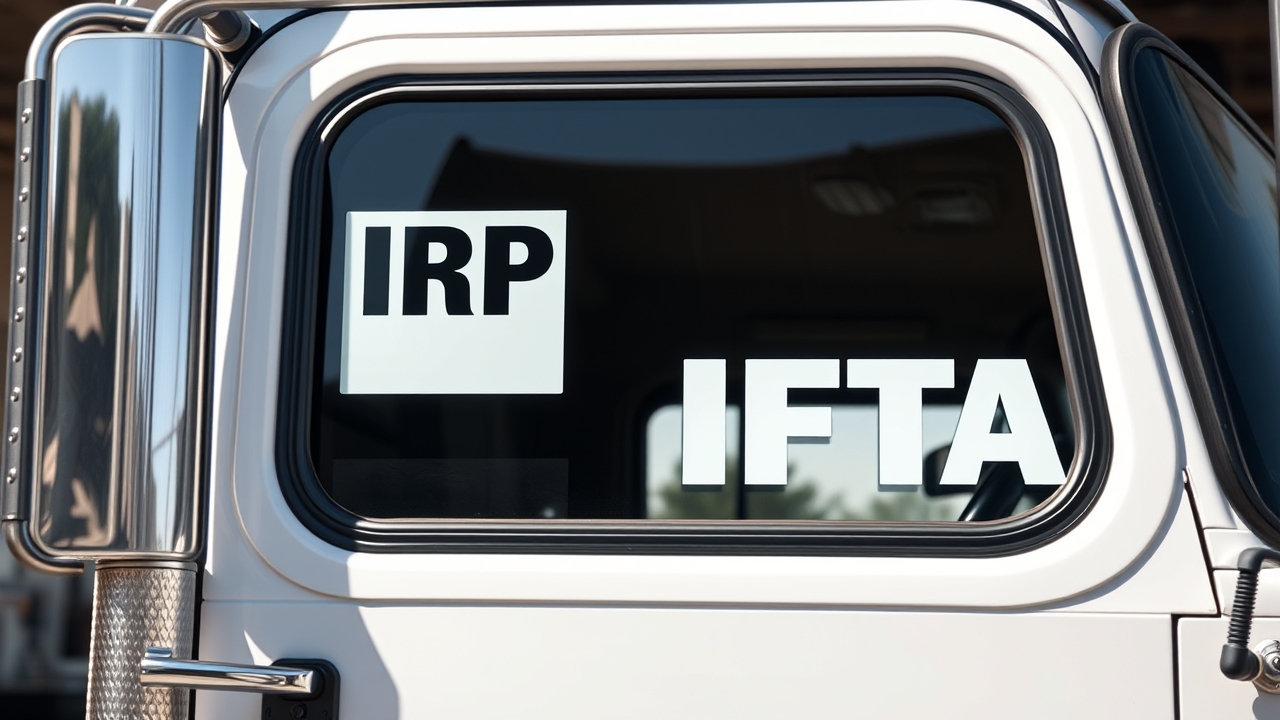
Every multi-state commercial truck driver knows the IRP IFTA decal combination plastered on the cab window or semi truck door lettering, but the requirements behind those stickers trip up a surprising number of operators at weigh stations. Placement rules, renewal windows, and what to do when a decal is lost or damaged all matter when an officer is looking at your cab at 2 a.m. in a DOT inspection lane.
IRP Decal Requirements: The Basics
The International Registration Plan (IRP) is a reciprocal agreement among 48 U.S. states, the District of Columbia, and 10 Canadian provinces. It allows commercial vehicles to travel across jurisdictions under a single apportioned registration plate rather than buying separate plates for each state.
Vehicles registered under IRP display an apportioned license plate and, in most base jurisdictions, a cab card. The cab card lists the jurisdictions the vehicle is registered to operate in and the weight for each. Many jurisdictions also issue IRP decals, typically a sticker placed on the vehicle identifying it as properly registered under the plan.
IRP applies to vehicles used in two or more member jurisdictions that have a gross vehicle weight rating over 26,000 lbs, or have three or more axles regardless of weight, or are part of a combination that exceeds 26,000 lbs. Smaller vehicles are generally not subject to IRP registration.
What the IRP Cab Card Covers
The cab card must be carried in the vehicle at all times when operating. It shows:
- Vehicle identification number and license plate number
- Registered weight for each member jurisdiction
- Registration expiration date
- Base jurisdiction contact information
IFTA Decal Requirements: What Changes Every Year
The International Fuel Tax Agreement (IFTA) simplifies fuel tax reporting for carriers operating in multiple jurisdictions. Instead of filing separate fuel tax returns in each state, a carrier files a single quarterly return with their base jurisdiction, which distributes the tax revenue to each state based on miles driven there.
IFTA participation requires displaying two decals, one on each side of the cab. Jurisdictions issue new decals annually, and the deadline is typically January 1. Most base jurisdictions allow a grace period through February to give carriers time to receive and apply new credentials.
IFTA decals are issued by the base state directly, not purchased from a vendor. If you are newly registering or renewing, you apply through your state’s motor carrier division. Indiana’s IFTA program is administered by the Indiana Department of Revenue.
IFTA Decal Specifications
Each IFTA decal displays:
- The letters “IFTA” and the base jurisdiction name
- The registration year
- The carrier’s IFTA account number
The decal color changes each year, which is how enforcement officers verify at a glance that a truck’s IFTA credentials are current. For 2025, most jurisdictions issued yellow decals. Driving with the prior year’s color after the grace period expires is an immediate compliance flag.
Placement Rules for IRP and IFTA Decals
IFTA regulations specify that decals must be placed on both sides of the cab. Most carriers put them on the lower half of the driver and passenger door windows, inside the glass. This protects them from weather and road debris while keeping them visible during inspections.
Some carriers mount IFTA decals on the exterior cab door below the window glass. Exterior placement is acceptable, but the decals degrade faster. Inside the window is the better long-term choice.
Where Not to Place IFTA Decals
- On the windshield, where they may obstruct the driver’s view
- On trailer doors or body panels (must be on the power unit)
- In a location not visible to an officer standing at the cab window
IRP Cab Card Placement
The IRP cab card is a document, not a decal, and must be carried in the vehicle. Many drivers keep it in the door pocket or visor clip with the other registration documents. Some carriers laminate the cab card for durability. Lamination is acceptable as long as the information remains legible.
Renewal Timelines and Grace Periods
Both IRP and IFTA credentials operate on annual renewal cycles, but the timing does not always align, which creates a window where one credential is current and the other is in process.
| Program | Renewal Window | Grace Period | Expiration Consequence |
|---|---|---|---|
| IRP | Varies by base state, typically 60-90 days before expiration | Varies by jurisdiction | Operating on expired plate is a violation; vehicle may be placed out of service |
| IFTA | Applications open in October-November for January credentials | Most jurisdictions allow January 31 or February 28 | Fine, potential audit, CSA points |
Indiana’s IFTA renewal window typically opens in November. Apply early. Processing delays happen, and operating with expired decals in January while waiting for the mail is a risk most carriers prefer to avoid.
Lost or Damaged IRP and IFTA Decals
IFTA decals that are lost, stolen, or damaged can be replaced by contacting your base jurisdiction’s motor carrier office. Most states charge a small replacement fee and process the request within a few business days. Until the replacements arrive, carry the receipt or confirmation number as proof that replacement decals are in process. That does not guarantee an officer will accept it, but it helps.
If a decal is peeling at the edges, replace it before it fully separates. A partially visible decal that cannot be read clearly is effectively a missing decal for compliance purposes.
Vinyl Lettering That Works Alongside Compliance Decals
IRP and IFTA decals are issued by the government, but the rest of your cab markings, including USDOT decal size requirements number, carrier name, and MC number, require separate vinyl lettering you supply yourself. Those must meet FMCSA marking requirements marking requirements under 49 CFR 390.21.
We have been making DOT compliance lettering at Hoosier Decal since 2003. A complete compliance set for one cab typically includes the USDOT number, carrier name, and MC number on Oracal 651 gloss cast vinyl sized at 2.5 inches tall. That set ships pre-spaced on transfer tape and applies in about 15 minutes per door.
See the complete USDOT requirements for Indiana guide for size charts and a state-by-state comparison of what markings are required beyond the federal baseline.
After applying FMCSA lettering, the next step for many carriers is adding their company name in larger lettering above or below the compliance information. That larger branding text improves roadside visibility and makes the truck easier to identify in a yard. Our guide to applying vinyl letters to a truck door covers how to align multiple lines of lettering so they sit straight on a curved door surface.
Frequently Asked Questions
Do IFTA decals need to be on both sides of the cab?
Yes. One decal on the driver side and one on the passenger side is required. Operating with only one decal in place is a violation, even if the decal on the other side fell off mid-trip. Carry a replacement with you if you operate in areas with aggressive winter road treatments that can lift adhesive edges.
What is the difference between IRP and IFTA?
IRP is about registration: it allows a truck to travel legally in multiple jurisdictions under one apportioned plate. IFTA is about fuel tax: it consolidates quarterly fuel tax reporting for carriers operating in multiple states. Both are required for most interstate commercial operations, but they are separate programs administered separately.
Can I drive without IFTA decals if I just got my new ones and they have not arrived yet?
During the standard grace period (usually through the end of January or February), yes. Most jurisdictions allow operation on the prior year’s credentials during this window. After the grace period ends, you need current credentials displayed. Contact your base jurisdiction for the exact grace period dates.
Do IFTA and IRP apply to owner-operators under a carrier’s authority?
An owner-operator leased to a motor carrier typically operates under the carrier’s IFTA and IRP credentials rather than their own. The carrier provides the cab card and decals. If you are operating under your own authority, you need your own credentials. Verify which arrangement your lease specifies.
Are box trucks under 26,000 lbs GVWR subject to IRP?
Not typically. IRP applies to vehicles over 26,000 lbs GVWR, or three-or-more axle vehicles, or combinations exceeding 26,000 lbs. A straight box truck under that weight used only intrastate is generally not subject to IRP. However, if that truck crosses state lines regularly, state laws in each jurisdiction apply. Consult a transportation attorney or your base state motor carrier office for a definitive answer on your specific vehicle configuration.
Next Steps
IRP and IFTA decals come from your state agency, but your USDOT, carrier name, and MC number lettering comes from us. USDOT decal cost your compliance vinyl lettering at our vinyl lettering builder, or upload your artwork if you need logo integration alongside the required text. We produce every order in Indiana and ship to all 48 contiguous states.
