
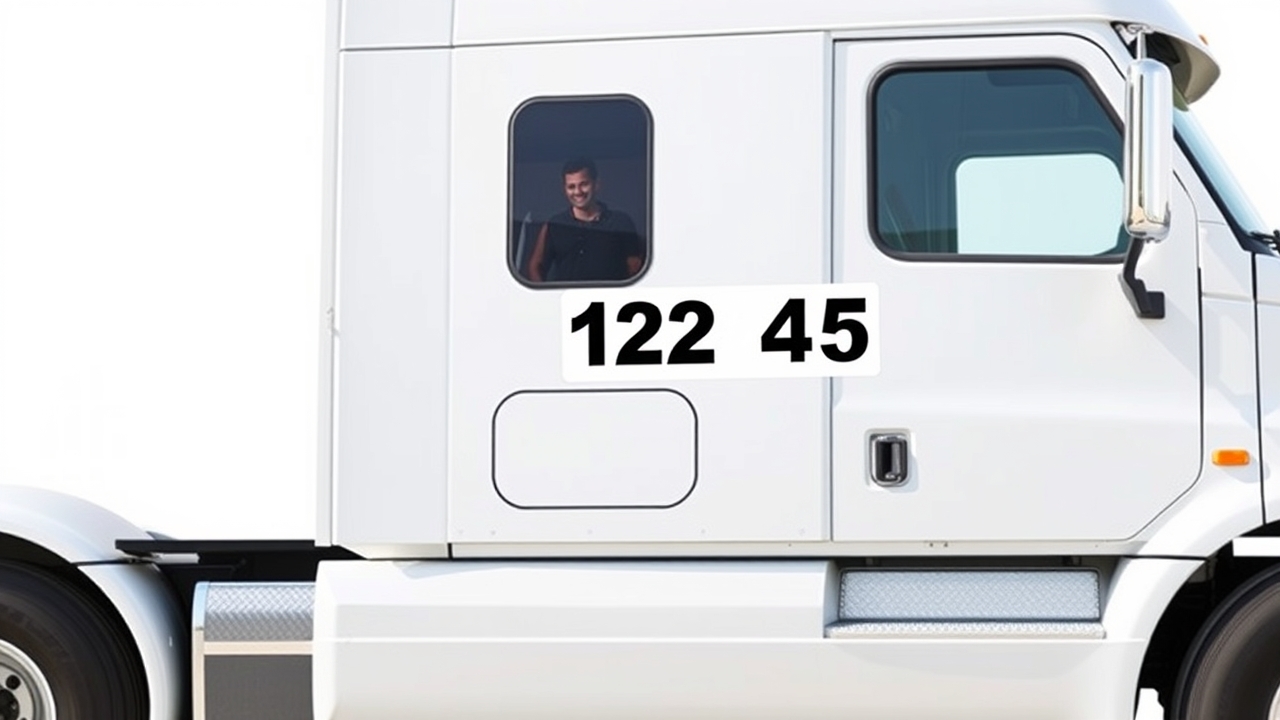
FMCSA marking requirements catch a lot of carriers off guard during roadside inspections, especially owner-operators who handle their own compliance. The rules are specific about USDOT decal size requirements, contrast, and what information must appear on both sides of the vehicle. Getting them wrong means fines and out-of-service orders that USDOT decal cost more than a new set of vinyl lettering ever would.
What FMCSA Marking Requirements Actually Cover
The Federal Motor Carrier Safety Administration sets marking rules under 49 CFR Part 390.21. The core requirement is that every CDL truck marking rules must display specific identification on both sides of the vehicle in a legible format. This applies whether the truck is a straight box truck or a semi pulling a trailer across state lines.
Required information breaks down into three categories:
- The carrier’s legal name or a single trade name registered with FMCSA
- The USDOT number preceded by the letters “USDOT”
- The motor carrier number (MC, MX, or FF number) for regulated for-hire carriers
Private carriers transporting their own freight do not need to display an MC number, but they still need the USDOT number and company name. Hazardous materials carriers have additional placard requirements under a separate regulatory chapter that FMCSA enforces alongside the basic marking rules.
Who Must Comply with FMCSA Marking Requirements
The threshold is vehicles with a gross vehicle weight rating (GVWR) over 10,000 lbs operating in interstate commerce. If you cross a state line at any point in your regular route, you are subject to federal marking requirements regardless of what state you are based in.
Intrastate-only carriers fall under state-level regulations, which vary. Some states mirror the federal rules exactly. Others set different GVWR thresholds or require additional state-specific identification. Our breakdown of USDOT requirements for Indiana covers the specific state-level rules for carriers based in the Midwest.
Vehicles That Must Be Marked
- Class 3 through Class 8 trucks and tractors in interstate commerce
- Buses with a GVWR over 10,000 lbs used for interstate passenger transport
- Combination vehicles (tractor-trailer) where the combination exceeds 10,000 lbs
Vehicles Generally Exempt from Federal Marking
- Pickup trucks under 10,001 lbs GVWR operating intrastate only
- Personal use vehicles not engaged in commerce
- Agricultural vehicles operating within 150 miles of the farm of origin (separate exemption applies)
Letter Size and Contrast: The FMCSA Specifications
This is where most violations happen. The regulation requires letters at least 2 inches tall. That is a minimum, not a target. Many enforcement officers flag smaller text even when the carrier insists it is compliant. Cutting at exactly 2 inches leaves no margin for error.
Our standard DOT number sets come in 2.5 inches tall, which reads clearly and gives a visible buffer above the minimum. For box trucks with large semi truck door lettering panels, 3-inch lettering fills the space better and reads at a longer distance.
Contrast Requirements
The regulation says the marking must be in a color that contrasts with the background color of the vehicle. That means white lettering on a dark truck and black or dark lettering on a white or light-colored truck. The regulation does not specify a particular color, just sufficient contrast to be legible.
A common mistake is putting dark grey lettering on a medium grey truck. The contrast ratio fails even when it looks fine in the shop lighting. When in doubt, go with black-on-white or white-on-black.
Durability Requirements
Markings must be legible from 50 feet in daylight. Faded, peeling, or damaged lettering that obscures any part of the required information is a violation even if the marking was once compliant. Inspect your lettering annually. Cast vinyl from Oracal 651 or 3M Scotchcal typically holds legibility for 6 to 7 years, but road damage and chemical exposure from dock areas can shorten that.
Placement Rules Under 49 CFR 390.21
Required markings must appear on both sides of the power unit. For a tractor-trailer, markings on the tractor doors satisfy the requirement for the power unit. Trailers have separate marking requirements under 390.21(c) that involve the name and USDOT number on the trailer sides as well.
The regulation does not specify that markings must be on the door panel specifically. However, the door is the default location because it is visible when the vehicle is parked or stopped at an inspection station. Placing markings on the fender behind the wheel well or on a panel that is obscured when a sleeper cab door opens can create practical compliance problems even if the placement technically meets the letter of the rule.
Trailer Marking Requirements
Trailers over 10,001 lbs GVWR used in interstate commerce must display the operating carrier’s name and USDOT number on the sides. The minimum height is also 2 inches. Intermodal chassis and certain leased trailers have additional rules about whose markings must appear when the trailer is operated by someone other than the trailer owner.
Common FMCSA Marking Violations and Their Costs
Roadside safety inspection forms use the Driver-Vehicle Examination Report (DVER) to record marking deficiencies. A marking violation alone typically results in a warning or a fine rather than an out-of-service order, but it affects your CSA safety score. Enough CSA violations and your carrier gets flagged for audit.
| Violation Type | Typical Consequence | Fix |
|---|---|---|
| Missing USDOT number | Fine up to $11,000 per violation | Apply compliant vinyl lettering before next operation |
| Letters below 2-inch minimum | Warning or fine, CSA points | Replace with correct-size lettering |
| Insufficient contrast | Warning, CSA points | Replace with contrasting color |
| Missing carrier name | Fine, CSA points | Add legal name to both sides |
How Vinyl Lettering Solves the FMCSA Compliance Problem
Vinyl cut lettering is the most practical way to meet FMCSA marking requirements on any vehicle. It goes on in minutes, looks clean, and can be replaced if your USDOT number changes due to reregistration. Paint is permanent and expensive to redo when regulations change or when you sell the vehicle.
We have been producing DOT compliance lettering since 2003. A standard set includes the USDOT number, carrier name, and MC number on Oracal 651 gloss cast vinyl, sized to your spec, with transfer tape applied and installation instructions included. They arrive ready to apply.
Applying them correctly takes about ten minutes per side. Our guide on how to apply vinyl letters to a truck door covers the step-by-step process for clean, bubble-free installation even on textured truck door surfaces.
Frequently Asked Questions
Do magnetic signs satisfy FMCSA marking requirements?
Yes, if they meet the size, contrast, and information requirements. However, magnetic signs can fall off at highway speed or be removed, and a vehicle caught operating without the markings in place is still in violation. Permanent vinyl lettering eliminates that risk for regular commercial vehicles. Magnetic signs are a reasonable option for vehicles that change carrier assignment frequently.
What happens if my USDOT number changes?
If your DOT number changes due to re-registration or a carrier change, you must update the markings before operating the vehicle. Old lettering must be removed or completely covered. Vinyl peels off cleanly with a heat gun. Order a new set with the updated number and apply it that day.
Do I need the USDOT number on a leased truck?
Yes, but whose number depends on the lease arrangement. Under a full-service lease where the lessor operates the truck, the lessor’s USDOT number applies. Under a trip lease to another carrier, the operating carrier’s number must be displayed. Review your lease agreement and consult the leasing company’s compliance department for specifics.
Are there marking requirements for refrigerated trailers?
Yes. Refrigerated trailers used in interstate commerce follow the same basic 390.21 requirements as dry vans. The reefer unit itself does not require separate marking, but the trailer body must show the operating carrier’s name and USDOT number on both sides at the 2-inch minimum height.
How far in advance should I order compliance lettering for a new truck?
Standard production at Hoosier Decal takes 1 to 3 business days, and ground shipping to most of the continental US adds 1 to 2 days. Order as soon as you have your USDOT number and carrier name confirmed. Rush production and overnight shipping are available if you need the truck on the road immediately.
Next Steps
Ordering compliant FMCSA marking lettering takes less time than a roadside inspection. Use our vinyl lettering builder to enter your USDOT number, carrier name, and MC number at the correct size. If you need to upload a logo or existing design file to match current truck graphics, the upload-artwork tool handles the rest. We ship from Indiana and produce every order USA-made.
