
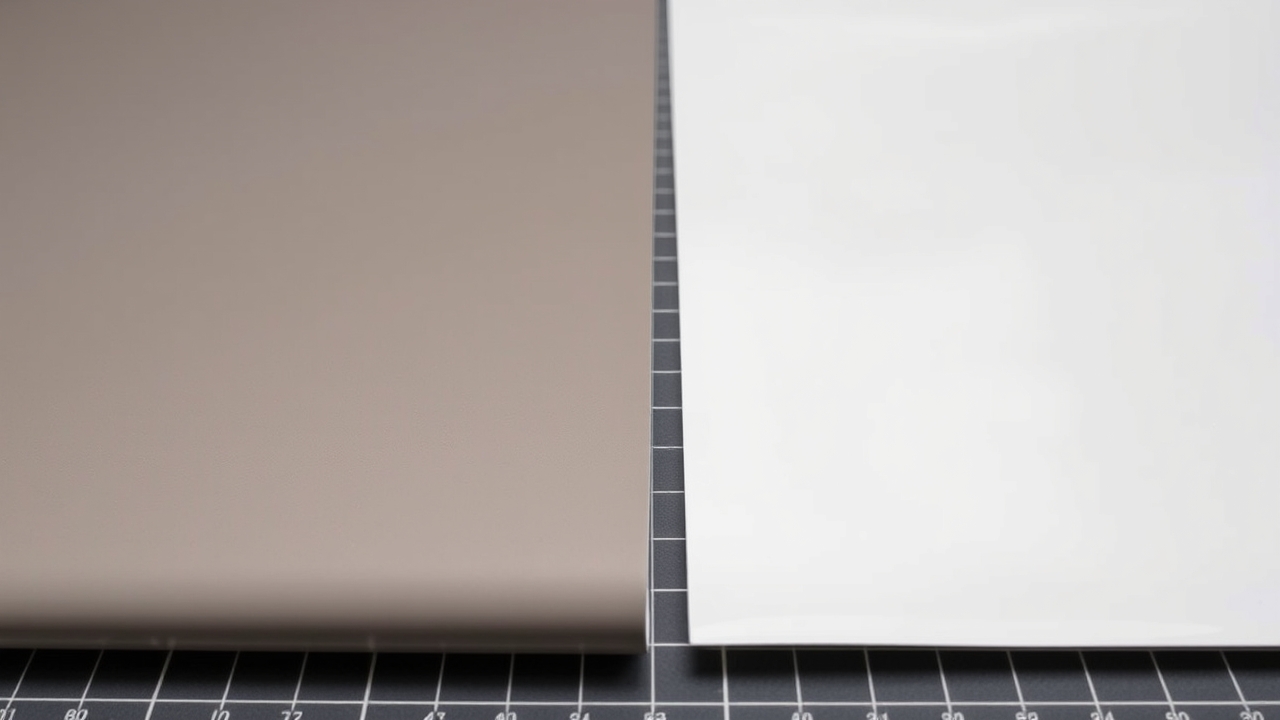
Cast vs calendered vinyl is the most fundamental material question in the vinyl lettering and vehicle graphics industry. The two film types come from completely different manufacturing processes, which produces differences in thickness, conformability, dimensional stability, and outdoor durability that directly affect how long your lettering stays on the vehicle and how it looks when you take it off. Understanding the distinction saves you from ordering the wrong material and dealing with lifting edges two years into a five-year application.
How Cast and Calendered Vinyl Are Made
The names describe the manufacturing process directly.
Calendered Vinyl Production
Calendered vinyl starts as a thick billet of compounded PVC. It gets fed through a series of heavy steel rollers that progressively flatten and thin it to the target thickness, typically 2.5 to 4.0 mils for vehicle lettering grades. The rollers are the calendering step, hence the name. The process is fast and efficient, which is why calendered film costs less. The downside: the mechanical pressure of the rollers leaves internal stress in the PVC film. That stress is always trying to relax, which makes the film want to shrink back toward its original shape over time.
Cast Vinyl Production
Cast vinyl starts as a liquid PVC solution. The formula is poured (cast) onto a casting sheet, which is a specially treated release paper, and drawn out to the target thickness by a precision coating blade. The liquid film then passes through an oven where the solvents evaporate and the PVC cures. Because no mechanical pressure is applied, the PVC molecules arrange themselves without stress. The result is a dimensionally stable film that does not try to shrink after application. Cast films are thinner (typically 2.0 mils) and more conformable than calendered equivalents.
Physical Differences Between Cast and Calendered
| Property | Calendered | Cast |
|---|---|---|
| Thickness (typical) | 2.5 to 4.0 mil | 1.5 to 2.5 mil |
| Internal stress | High (from roller pressure) | None (liquid casting) |
| Dimensional stability | Moderate (tends to shrink) | Excellent (stable) |
| Elongation at break | 80-120% | 150-250%+ |
| Surface feel | Slightly stiffer | More flexible, conformable |
| Weight per sq ft | Heavier | Lighter |
The elongation difference is the key practical stat. A film that stretches 200 percent before breaking can wrap around a 90-degree edge and conform to a compound surface without tearing. A film that stretches 100 percent will lift and eventually tear when forced onto the same curve.
Durability: How Long Each Film Lasts
Outdoor durability ratings for vinyl films are measured by UV and weather resistance, not just tensile strength. The internal stress in calendered films accelerates degradation in two ways: dimensional shrinkage pulls edges away from the surface over time, and the plasticizer system in calendered films tends to migrate more aggressively in heat, leaving the film brittle faster.
Standard calendered intermediate vinyl (Oracal 651, 3M Scotchcal 220) carries a five to seven year outdoor rating. High-performance calendered films (Oracal 751) push that to seven years. Cast vinyl (Oracal 951, 3M 180C) is rated at ten to twelve years.
In practice, real-world durability varies by climate. In the Midwest, a flat-panel truck door lettered in Oracal 651 looks good at year five with minimal care. The same film on a dark-colored vehicle in Phoenix or South Florida may show edge lifting and color fade at year three to four because of the higher UV load and heat cycles.
Cast vinyl in the same Phoenix environment will typically still be performing acceptably at year seven. The chemistry difference is real and field-observable, not just a marketing claim.
Conformability: Curved Surfaces and Complex Body Lines
This is where cast vs calendered vinyl produces the most visible performance difference in vehicle lettering applications.
Modern truck and van bodies are not flat. They have character lines, door handle recesses, curved front quarter panels, and ribbed rocker panels. Calendered vinyl can handle flat panels and mild single-axis curves (like a flat door with a slight bow) without problems. It cannot conform to tight curves, recessed areas, or compound curves (curves in two directions at once) without bridging across the contour and eventually lifting.
Cast vinyl conforms to compound curves because of its higher elongation and lack of internal stress. You can heat it, stretch it around a tight edge, and it stays in the stretched position without springing back. For riveted trailer sides, cargo van door edges, and pickup truck bed rails, cast vinyl is the correct material.
If you are lettering a transit van with pronounced body lines or a work truck with complex curves, our application guide at how to apply vinyl letters to a truck door explains the technique differences between flat and curved surface application.
Cost Comparison: What You Pay and What You Get
Calendered vinyl costs 40 to 60 percent less per square foot than equivalent cast vinyl at the material level. For a simple one-color lettering kit on a truck door, this might translate to $30 to $50 less per vehicle. For a 20-truck fleet, that is $600 to $1,000 in material savings upfront.
The total cost picture over time reverses the calculation when the application calls for cast vinyl but you use calendered. If calendered film fails at year four on a surface that cast film would have held for eight years, you pay for removal, new material, and application labor twice. One replacement cycle on a 20-truck fleet wipes out the initial savings and then some.
The right question is not which material costs less today but which material costs less over the intended service life of the application. For flat panels in moderate climates with a three to five year expected life, use calendered and save the money. For complex curves, harsh climates, or long service requirements, cast vinyl is the economical choice over time.
When to Use Cast vs Calendered Vinyl
Use calendered vinyl when:
- The surface is flat or only mildly curved
- The climate is moderate (Midwest, Northeast, Pacific Northwest)
- The application will be replaced within five years
- Cost is the primary constraint and the surface conditions allow it
- You need a specialty color only available in the calendered lineup
Use cast vinyl when:
- The surface has compound curves, tight bends, or ribbed panels
- The vehicle operates in high-UV climates (South, Southwest)
- The application needs to last seven or more years
- Fleet consistency over time is critical and early replacement would be disruptive
- Clean removal after a long service life matters
Brand Examples: Cast and Calendered Options We Stock
At Hoosier Decal, we cut from both film types depending on the project requirements.
For calendered applications, Oracal 651 is our standard choice for vehicle lettering. It offers over 80 colors, a proven five to seven year outdoor rating, and consistent adhesion on painted automotive finishes. For projects needing a step up in performance from 651 while staying in the calendered category, Oracal 751 handles more demanding curves and heat environments better.
For cast applications, Oracal 951 is our primary cast film for die-cut lettering. Its 12-year outdoor rating and 200 percent elongation make it the right material for complex surfaces and long service requirements. For customers specifying 3M materials, the Scotchcal 180C series performs comparably to the 951 at the cast film level.
Finish choice applies across both categories. Both cast and calendered films come in gloss and matte versions. The performance differences between gloss and matte in terms of durability are minimal; the choice is primarily visual. See our matte vs gloss vinyl finish guide if you need help choosing.
Frequently Asked Questions
Is cast vinyl always better than calendered?
Not always. On flat surfaces in moderate climates with a short to medium service expectation, calendered vinyl performs the same as cast at lower cost. Cast vinyl’s advantages (conformability, dimensional stability, longevity) only matter when the application requires them. Buying cast vinyl for a flat storefront sign that gets replaced every two years is unnecessary spending.
Can I tell cast from calendered by looking at it?
Not reliably from appearance alone. Cast film is generally thinner and feels more flexible when you bend the roll, but the visual difference is subtle. The clearest indicator is the product specification. Oracal 651 and 751 are calendered. Oracal 951 is cast. 3M Scotchcal 220 and 3630 are calendered. 3M 180C is cast. When in doubt, look up the product code.
How do I apply cast vinyl differently from calendered?
The basic squeegee application process is the same. Differences: cast film is more sensitive to surface contamination (clean carefully); use moderate squeegee pressure since heavy pressure can distort thin cast film; heat the film when wrapping edges because cast film stretches cleanly with heat and holds the stretched position without springing back.
Why does cast vinyl remove more cleanly after long use?
Cast film maintains its structural integrity longer because it has no internal stress and its plasticizer system is more stable. When you peel a 7-year-old cast film, it comes off in one intact piece. A 7-year-old calendered film may have become brittle and tears into small fragments, making removal more labor-intensive.
Does cast vinyl cost more to apply professionally?
Professional installation labor costs are similar for both materials. Some applicators charge a slight premium for cast film on complex wraps because the technique requires more care, but for standard vehicle lettering, the labor cost is the same. The material cost difference is the primary cost factor.
What about intermediate films like Oracal 751? Are they cast or calendered?
Oracal 751 is a high-performance calendered film. It is a step above 651 in heat resistance and conformability because of a better plasticizer formulation, but it is still manufactured through the calendering process. It bridges the performance gap between standard intermediate films and cast vinyl without reaching full cast film conformability or longevity. See our full Oracal 651 vs 751 comparison for details.
Next Steps
Now that you know the difference, choosing the right vinyl for your project is straightforward. Start your lettering order at our vinyl lettering builder, where you can select your material grade, or upload your artwork for a custom production quote. If you are not certain which film tier fits your vehicle and climate, contact us with your details and we will recommend the right material from our Oracal and 3M Scotchcal stock. Hoosier Decal has been cutting vinyl since 2003 in Indiana, shipping nationwide.
