
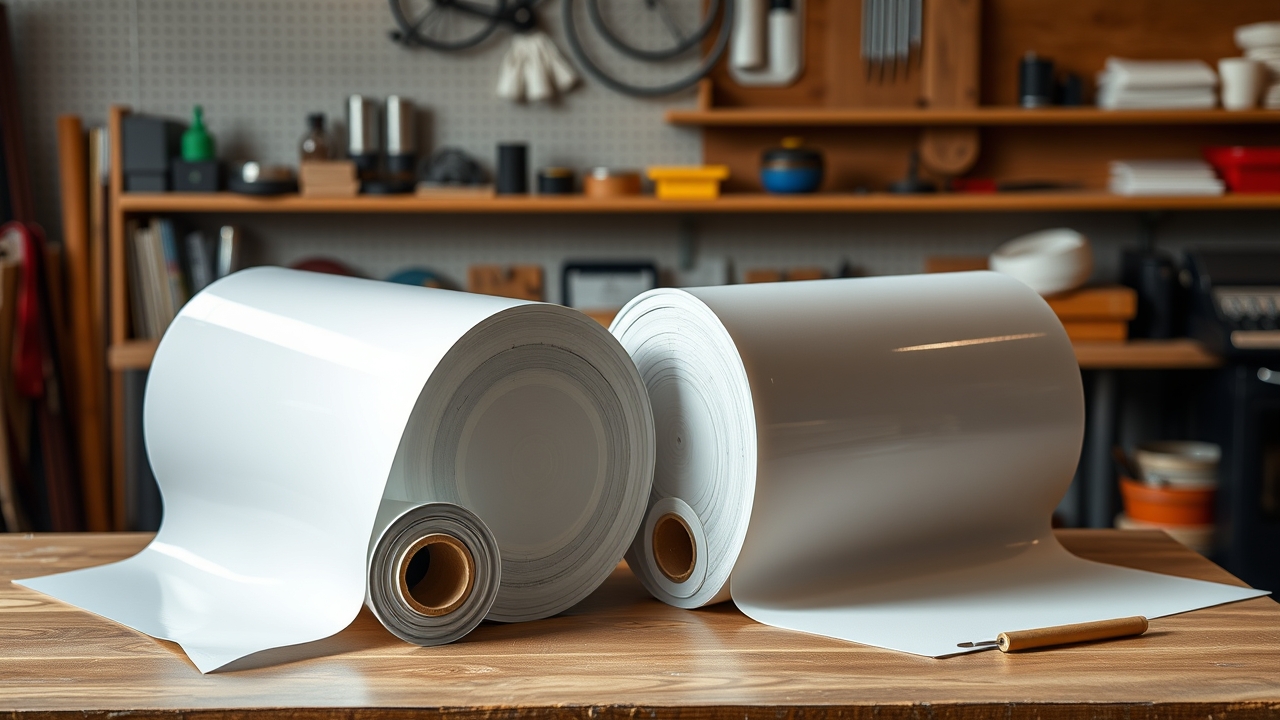
Oracal 651 vs 751 is one of the most common questions we get from sign shops, fleet managers, and DIY lettering customers. Both films come from the same Austrian manufacturer and look nearly identical in the roll. The differences show up in real-world applications, particularly when temperature, surface curves, and longevity are on the line.
Quick Overview: What Sets These Two Films Apart
Oracal 651 is a calendered intermediate vinyl. Oracal 751 is a monomeric high-performance vinyl. Calendered films are manufactured by running molten PVC through rollers under pressure, a process that is efficient but leaves internal stress in the material. That stress causes the film to try to shrink back to its original flat shape over time, which matters when you are wrapping curves.
Oracal 751 uses a higher-quality PVC formulation with a different plasticizer system. The result is a more stable film that holds its shape on curved surfaces better and resists heat-induced shrinkage over a longer service life. Both films are gloss-finished in their standard versions, though both also come in matte from Oracal’s broader lineup.
Oracal 651: The Workhorse of Intermediate Vinyl
Oracal 651 has been the default choice for vehicle lettering, storefront signs, and equipment marking for decades. It is available in over 80 colors from Oracal’s Series 600 palette, including metallics, translucents, and fluorescents. The adhesive is a solvent-based pressure-sensitive system rated for five to seven years outdoors.
Where 651 Excels
- Flat or gently curved surfaces: van sides, truck doors, flat sign panels
- Short to medium-term applications: two to five year lifespan expected
- Color variety: the 651 lineup is broader than 751 for specialty colors
- Cost: 651 runs 20 to 30 percent less per square foot than 751
- Indoor applications: banners, wall lettering, equipment labels
Where 651 Struggles
Tight curves cause problems for 651. If you try to wrap it around a 90-degree edge or into a concave surface, the film will lift at the edges within months. In direct sun at temperatures above 120 degrees Fahrenheit (common on dark vehicle surfaces in Southern states), 651 can begin to shrink at the edges in year three or four. For flat panel truck lettering in Indiana’s climate, this is rarely a problem within the expected service life.
Oracal 751: High-Performance Calendered Vinyl
Oracal 751 is positioned as Oracal’s premium calendered product. The manufacturer rates it at seven years outdoors, and independent sign industry testing generally confirms that it outperforms 651 by 18 to 24 months in high-UV environments. The plasticizer migration is slower, meaning the film stays flexible longer without becoming brittle.
Where 751 Excels
- Complex body lines: Transit vans, pickup truck beds, curved door panels
- Dark vehicle surfaces in high-sun climates: the film resists heat shrinkage better
- Long-term fleet applications where five-plus years of adhesion is required
- Applications requiring clean removal after five or more years
Where 751 Is Overkill
For flat storefront window lettering, indoor signs, or any application where the vinyl will be replaced in two to three years, 751 offers no practical benefit over 651. The extra cost adds up fast on large orders. A church van fleet using 751 when 651 would suffice might pay 25 percent more for no real-world gain in performance.
Side-by-Side Comparison: Oracal 651 vs 751
| Feature | Oracal 651 | Oracal 751 |
|---|---|---|
| Outdoor rating | 5-7 years | 7+ years |
| Film type | Calendered intermediate | High-performance calendered |
| Conformability | Good (flat to mild curves) | Better (handles complex curves) |
| Heat resistance | Moderate | Good |
| Color range | 80+ colors | 40+ colors |
| Relative cost | Lower | 20-30% higher |
| Best use | Flat panels, short term | Curves, long term, fleet |
Which Film Should You Choose?
The choice between Oracal 651 and 751 comes down to three factors: the surface you are applying to, the climate the vehicle operates in, and how long you need the lettering to last.
Choose 651 if: your vehicle has flat panels, you are in the Midwest or Northeast, the application will be replaced or the vehicle sold within five years, or you need a specialty color only available in the 651 range.
Choose 751 if: your vehicle has complex curves, it sits in direct sun in the South or Southwest, you need consistent adhesion for seven or more years, or you are lettering a fleet where early failures require expensive re-dos.
At Hoosier Decal, we use Oracal 651 as our standard material for most vehicle lettering orders. We recommend upgrading to 751 (or to Oracal 951 cast vinyl for the most demanding applications) when the customer’s situation calls for it. If you are not sure which applies to your project, let us know your vehicle type and location when you order and we will flag the right material.
Application Notes for Both Films
Both 651 and 751 apply the same way: clean surface, position with transfer tape, squeegee firmly, peel tape at a low angle. The main difference in practice is that 751 has slightly more stretch, which helps when working around door handles and mild contours.
Temperature matters for both. Apply above 50 degrees Fahrenheit and below 90 degrees for best adhesion. Let the adhesive cure for 24 hours before washing. Avoid pressure washing the edges of any vinyl lettering, which is the number one cause of premature lifting regardless of which film you use.
For a full application walkthrough, our guide on how to apply vinyl letters to a truck door covers the wet and dry methods with specific tips for large panels.
Finish choice also affects longevity. High-gloss finishes show scratches more on vehicles that go through automatic car washes frequently. If you want the data on finish durability, see our matte vs gloss vinyl finish comparison.
Frequently Asked Questions
Is Oracal 651 good for outdoor vehicle use?
Yes. Oracal 651 is the industry standard for vehicle lettering in moderate climates. Its five to seven year outdoor rating covers the expected service life of most fleet and commercial vehicle lettering programs. In the Midwest, South, and Northeast, 651 performs reliably on flat door panels and rear windows.
Can I use Oracal 651 on curved surfaces?
For mild curves (like a standard sedan door), yes. For tight curves, compound curves, or rivet-covered panels, 651 will lift at the edges over time. In those cases, upgrade to 751 or, for extreme applications, to cast vinyl like Oracal 951.
Does Oracal 751 come in the same colors as 651?
Not exactly. Both lines share many core colors (black, white, red, blue, etc.) but the 651 Series 600 palette is significantly broader, especially in specialty colors like fluorescents, metallics, and translucents. If you need a specific specialty color, check the 651 lineup first.
Which is easier to remove: 651 or 751?
Both remove similarly from factory paint in good condition when heated properly. Oracal 751 actually removes slightly more cleanly after five or more years because the plasticizer system breaks down less. On very long installations (seven-plus years), 651 may leave more adhesive residue requiring extra solvent work.
How does Oracal 651 compare to 3M Scotchcal?
Oracal 651 and 3M Scotchcal 220 Series are comparable intermediate films with similar outdoor ratings. 3M’s color consistency system is slightly more formalized for multi-location brand programs, while Oracal’s broader color palette gives more creative options for single-vehicle applications. Both are reliable choices at the intermediate film level.
What about Oracal 951? When should I use that instead?
Oracal 951 is a cast vinyl, which means a fundamentally different manufacturing process that produces a thinner, more conformable film with a longer outdoor rating (up to 12 years). Use 951 for full wraps, complex compound curves, or any application where you need the vinyl to conform to riveted panels or extreme body lines. It costs more than either 651 or 751.
Next Steps
Ready to order lettering for your vehicle or fleet? Choose your material in our builder and we will cut it to spec. Start at create vinyl lettering for text-based designs, or upload your artwork if you have a print-ready file. Not sure which material is right? Contact us with your vehicle details and we will recommend the best option from our stock of Oracal and 3M Scotchcal films.
