
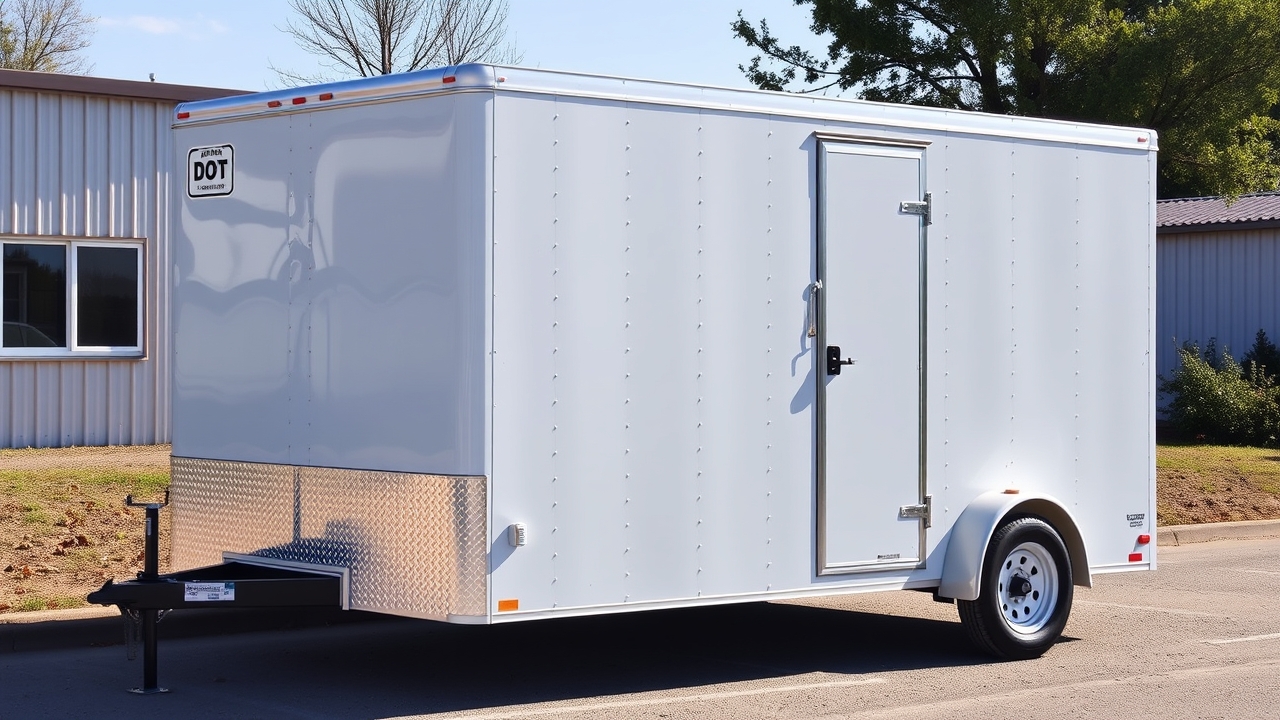
Enclosed trailer lettering requirements catch a lot of small carriers and owner operators off guard. The rules are not complicated, but skipping required identification or getting the sizing wrong creates real problems at weigh stations and roadside inspections. Hoosier Decal has been cutting DOT-compliant trailer lettering since 2003, and we put this guide together to help you get it right before your trailer hits the road.
What FMCSA Requires on Enclosed Trailers
If your enclosed trailer is part of a commercial motor vehicle combination operating in interstate commerce, 49 CFR Part 390.21 requires specific identification markings. The same rule that governs tractor cab doors also covers trailers, though trailers have slightly different placement options.
Required Information
- Legal name or single trade name of the motor carrier
- City and state of the principal place of business
- USDOT number (preceded by the letters “USDOT”)
- MC number, if the carrier holds interstate operating authority
All of this information must appear on both sides of the trailer. The driver side and curb side both need complete markings. A trailer marked on one side only is non-compliant regardless of how neat the lettering looks.
What Does Not Need to Be on the Trailer
The USDOT number on the trailer can match the tractor’s USDOT number if the tractor and trailer are operated by the same carrier. If the trailer is leased from a different entity, the operating carrier’s information must appear on the trailer during the lease period. This trips up owner operators who rent or lease trailers without updating the markings before putting them in service.
Our state DOT requirements guide covers state-specific additions that may apply in your operating territory on top of the federal baseline.
FMCSA Sizing Requirements for Trailer Lettering
The minimum character height for required identification markings on a trailer is 2 inches. The text must contrast with the background and be legible from 50 feet in daylight. That 2-inch minimum is the legal floor, but it is tight. A trailer that is moving on a highway or sitting in a busy terminal is more readable when the required identification runs at 2.5 to 3 inches.
Practical Sizing Recommendations
| Text Line | FMCSA Minimum | Recommended for Legibility |
|---|---|---|
| Company Name | 2 inches | 3 to 4 inches |
| City, State | 2 inches | 2.5 inches |
| USDOT Number | 2 inches | 2 to 2.5 inches |
Running the company name larger than the USDOT line creates a natural visual hierarchy. An inspection officer reads the USDOT number to verify the carrier; a motor carrier compliance officer reads the company name to confirm it matches the registration. Both audiences benefit from clear separation between those two text elements.
Where to Place Enclosed Trailer Lettering
FMCSA allows trailer lettering on the side panels of the trailer. Most carriers choose the rear half of the trailer’s side wall for the required identification block, often paired with the company name on the forward section in larger letters for branding purposes.
Avoid placing required identification on the rear door panels or across the nose of the trailer. Those surfaces are harder to read in normal traffic conditions and do not satisfy the “both sides” requirement. The side wall is the correct location.
Height Off Ground
There is no specific ground-clearance requirement in the FMCSA rule, but practical placement is between 18 inches and 60 inches from the ground so the text is readable without bending down or craning up. Most standard enclosed trailers have panels that naturally land in that range.
For the application process once your vinyl is in hand, our vinyl application guide covers the transfer-tape method that works on trailer side panels as well as truck doors and flat body panels.
Vinyl Material for Long-Life Trailer Lettering
Enclosed trailers spend their working lives exposed to highway conditions, loading dock environments, and overnight exterior storage. The vinyl needs to survive rain, UV exposure, occasional power washing, and the flex stress that comes from road vibration over tens of thousands of miles.
Cast vinyl from Oracal (series 651) or 3M Scotchcal is the standard for trailer lettering because it is UV-stable, pressure-sensitive, and rated for 6-8 years on exterior vertical surfaces. It cleans up with a pressure washer without lifting, and it handles the freeze-thaw cycles that trailers sitting in northern states deal with every winter.
White lettering on a standard white trailer requires some thought. Dark gray or black lettering on the white trailer panel is the most readable option. Alternatively, applying a contrasting background strip in dark vinyl and then mounting white lettering on it creates the required contrast without changing the overall trailer color scheme. This is common on food distribution and logistics trailers where the white exterior is a brand requirement.
When You May Be Exempt from Trailer Marking Requirements
Not all trailers require FMCSA markings. The key threshold is whether the vehicle is a “commercial motor vehicle” (CMV) under federal definition, which generally means it is used in interstate commerce and meets one of several criteria: gross weight over 10,001 pounds, designed to carry 9 or more passengers, or transporting hazardous materials requiring placards.
If your enclosed trailer is used purely for intrastate (within one state) hauling, federal regulations do not apply, though your state may have its own identification requirements. Private carriers hauling their own goods in intrastate commerce in many states are exempt from CMV markings entirely. That said, putting your company name and contact information on a trailer you own is good practice even when it is not legally required.
Frequently Asked Questions
Do I need my USDOT number on a trailer if it’s already on my tractor?
Yes. FMCSA requires both the tractor and the trailer to display the USDOT number of the operating carrier. The trailer markings must be present and legible independent of the tractor. If you swap trailers between trips (which most owner operators do), every trailer you pull in commercial service needs compliant markings.
What if the trailer belongs to a shipper or a leasing company?
If you have a lease or interchange agreement that places the trailer under your operating authority, your USDOT number and carrier identification must be on the trailer during the period of your operation. The owner’s name can remain on the trailer but cannot replace your required identification. Many carriers use temporary magnetic signs in this situation, though permanent vinyl is cleaner and avoids the risk of magnetic signs blowing off.
Can I use paint instead of vinyl for DOT lettering on trailers?
Paint is technically permitted as long as it meets the sizing and contrast requirements. In practice, vinyl is the preferred method because it can be replaced without repainting when you sell the trailer, update your USDOT number, or rebrand the company. Paint is permanent; vinyl is not. Virtually all professional carriers use vinyl.
How long does vinyl trailer lettering last?
Quality cast vinyl on a painted trailer panel is rated for 6-8 years. Real-world life varies based on washing frequency, chemical exposure (trailers around fertilizers or chemicals often see shorter life), and UV intensity in your operating region. Southern operators in high-UV states may see 5-6 years; northern operators often get the full 8 years or more.
Can I order trailer lettering for both sides as a matched set?
Yes, and that is the standard way we produce trailer lettering. We cut both sides from the same digital file, so the layout, sizing, and alignment are identical on both panels. Matched sets are packaged together and arrive transfer-taped and ready to apply. Ordering both sides at once is also more economical than ordering them separately.
What happens if my trailer is inspected and the lettering does not comply?
An officer can place the vehicle out-of-service for missing or non-compliant identification markings. You may also receive a fine, and the violation goes into your carrier safety record with FMCSA. Repeated violations affect your Compliance, Safety, and Accountability (CSA) score, which has downstream consequences for insurance rates and shipper relationships. Getting the lettering right before the trailer goes into service is far cheaper than a single out-of-service incident.
Next Steps
Get your enclosed trailer lettering ordered and compliant before your next run. Use our vinyl lettering tool to configure your carrier identification set, or upload your layout file for a custom quote. We cut in Indiana, ship fast, and every set is backed by two decades of DOT lettering experience.
